- How far is the Moon from Earth?
- The Moon orbits Earth at an average distance of 384,400 kilometres, roughly 238,855 miles. That gap is wide enough to fit every other planet in the solar system side by side. Light from the lunar surface reaches Earth in about 1.3 seconds, which is why the Moon feels close yet remains a genuine space exploration destination. The Moon's orbit is elliptical, so the distance varies between about 356,500 km at perigee and 406,700 km at apogee. This changing distance drives the apparent size difference between a supermoon and a micromoon, and it also shifts tidal strength on Earth. Every ExplOrbit Moon map records territory coordinates using the same selenographic latitude and longitude system that mission planners use for lunar landings.
- Why does the Moon have almost no atmosphere?
- The Moon has only a thin exosphere because its surface gravity is about 1.62 metres per second squared, roughly one sixth of Earth's gravity. That weak pull cannot hold gas molecules, so they escape into space. Without an atmosphere there is no weather, no sound, and no erosion, which is why lunar footprints and craters survive for millions of years. The absence of atmosphere makes the lunar surface exceptionally fragile. Nothing repairs damage. A rover track, a landing scar, or an industrial mining pit stays visible essentially forever. This permanence is the scientific reason lunar conservation matters: unlike Earth, the Moon has no natural process that heals disturbance. Protecting the regolith is protecting an unaltered 4.5-billion-year record.
- How many craters are on the Moon?
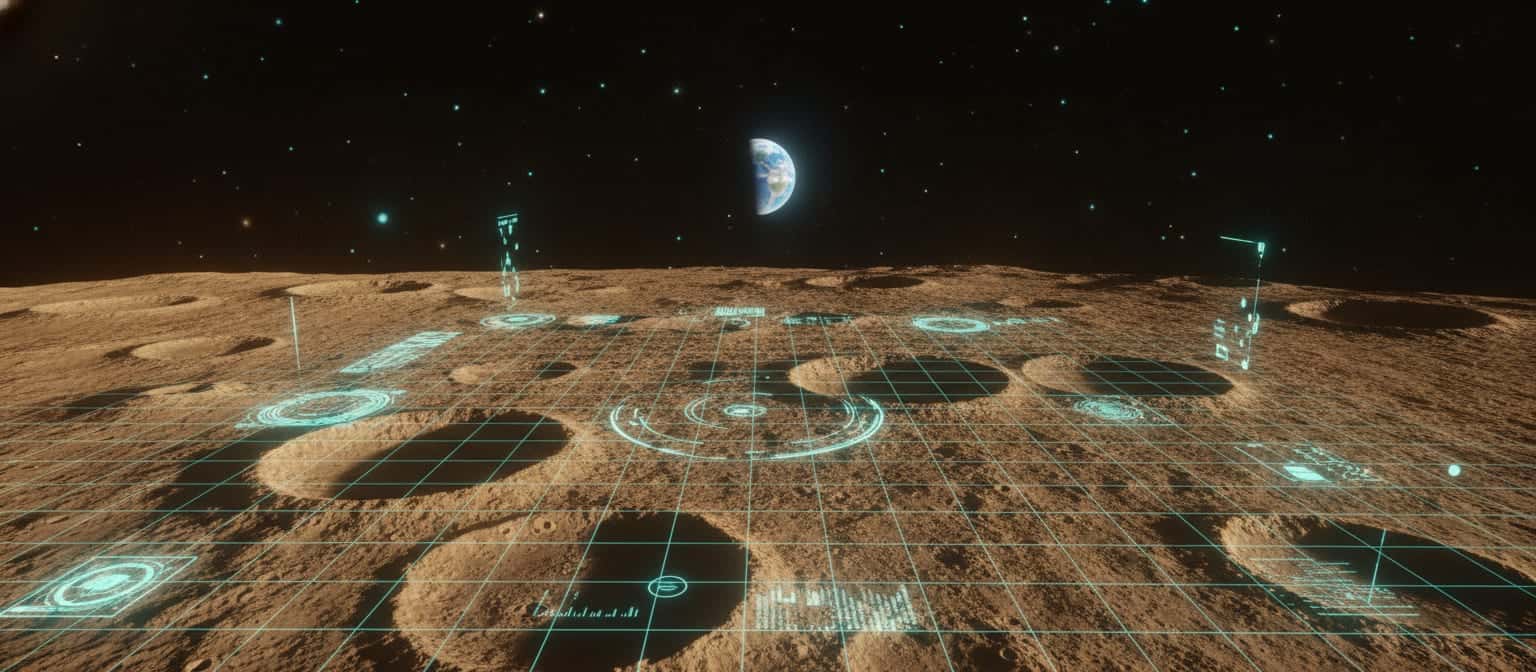
- The Moon carries more than 9,000 recognised impact craters, and over 300,000 craters wider than one kilometre on the near side alone. Meteors and asteroids have struck the surface for billions of years. With no atmosphere to burn up incoming meteors and no erosion to erase the scars, the Moon preserves the most complete impact record in the inner solar system. Craters such as Tycho, Copernicus, and Clavius are visible through modest astronomy equipment, making them favourite targets for anyone using a first telescope. The bright ray system radiating from Tycho was formed by ejecta thrown across the surface during impact roughly 108 million years ago. Crater counting is how planetary scientists date lunar terrain: more craters means older ground.
- Is there water on the Moon?
- Yes. Water ice has been confirmed in permanently shadowed craters near the lunar south pole, where temperatures stay below minus 160 degrees Celsius. NASA's LCROSS impact and the Moon Mineralogy Mapper both detected hydrogen signatures. These deposits make the polar regions the most scientifically valuable and most commercially contested ground on the Moon. Water ice matters because it can be split into hydrogen and oxygen for rocket propellant and life support, which turns the Moon into a refuelling station for deeper space exploration. That same value makes polar ice a target for mining on the Moon. ExplOrbit's premium 5-acre conservation territories are deliberately sited in these documented water-ice regions, because the places worth protecting most are the places under the greatest pressure.
- What is lunar regolith and why does it matter?
- Lunar regolith is the layer of fine dust and broken rock covering the Moon, formed over billions of years by meteor impacts grinding the surface. It sits 4 to 15 metres deep and its grains are razor sharp, never smoothed by wind or water. Regolith holds a chemical record of solar and cosmic history found nowhere on Earth. Regolith is both a scientific archive and an industrial target. It contains helium-3, rare earth elements, iron, titanium, and oxygen locked in mineral form, which is exactly why mining on the Moon is being seriously proposed. Once regolith is disturbed, the stratigraphic record it holds is destroyed permanently. Every ExplOrbit conservation pledge is specifically a pledge to leave the regolith of your recorded territory undisturbed.
- Why do we always see the same side of the Moon?
- The Moon is tidally locked to Earth, meaning it rotates once on its axis in exactly the time it takes to orbit Earth, about 27.3 days. The result is that one hemisphere permanently faces us. The far side was never seen by human eyes until the Soviet Luna 3 probe photographed it in 1959. Tidal locking is a natural consequence of gravity acting over billions of years. It also means an ExplOrbit territory on the near side sits under a permanent view of Earth hanging fixed in the sky, never rising and never setting. Our Earth-visible conservation territories are selected precisely for this: from that ground, Earth is always overhead.
- How old is the Moon?
- The Moon formed about 4.51 billion years ago, only around 60 million years after the solar system itself. The leading giant-impact hypothesis holds that a Mars-sized body called Theia struck the young Earth, and the debris thrown into orbit coalesced into the Moon. Apollo rock samples remain the primary evidence for this timeline. Because the Moon has no plate tectonics and no weather, its ancient crust is still exposed at the surface. Earth has erased almost all rock from that era, so the Moon is the closest thing we have to a physical archive of the early solar system. Damage to that surface is not a local loss, it is the loss of shared scientific heritage belonging to all of humanity.
- Who owns the Moon?
- No nation owns the Moon. The 1967 Outer Space Treaty, ratified by over 110 countries, prohibits any state from claiming sovereignty over the Moon or other celestial bodies. The treaty declares space the province of all humankind. No government, company, or individual holds legally recognised real-property title to lunar land. This is why ExplOrbit is explicit about what it offers. An ExplOrbit Conservation Certificate is a commemorative collectible and a recorded stewardship pledge within our own registry. It does not convey sovereign ownership or internationally recognised real-estate title, and we make no claim otherwise. We built ExplOrbit as a conservation coalition rather than a land-sales venture precisely because we agree with the treaty: the Moon belongs to all of humanity.
- Why does the Moon cause tides on Earth?
- The Moon's gravity pulls on Earth's oceans, raising a bulge of water on the side facing the Moon and another on the opposite side. As Earth rotates through these bulges, coastlines experience roughly two high tides and two low tides each day. The Sun contributes about a third of the total tidal effect. Tides shaped life on Earth. Tidal pools are a leading candidate for where early biochemistry took hold, and tidal rhythms still govern the breeding cycles of countless marine species. The Moon also stabilises Earth's axial tilt at around 23.4 degrees, which keeps our seasons regular. A stable climate history is a direct gift of having a large satellite.
- What makes a good space gift or astronomy gift?
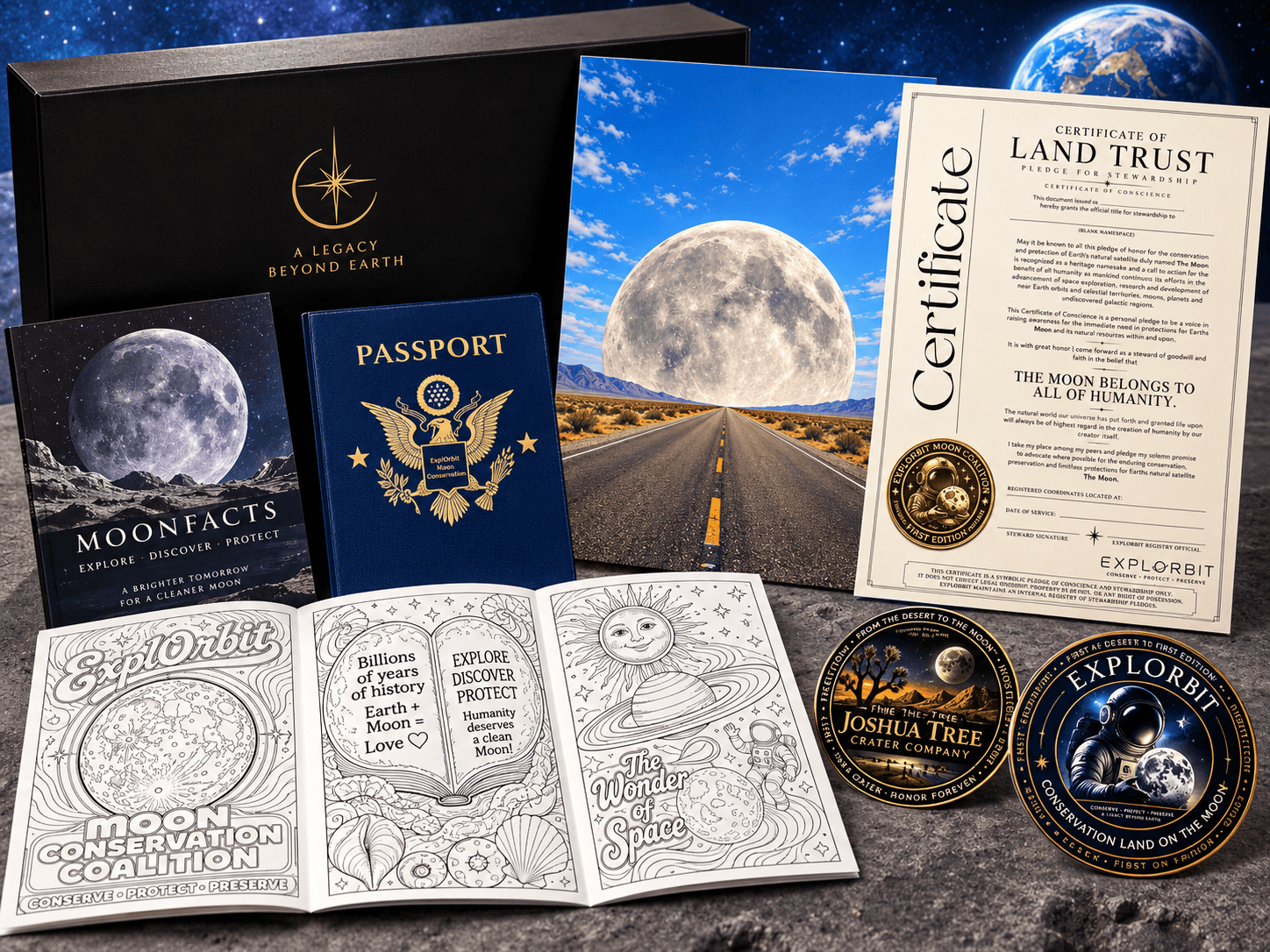
- The best space gifts connect a person to something real and lasting rather than a novelty that is forgotten in a month. A named Moon territory with recorded coordinates, a personalised certificate, and a star chart gives the recipient a specific place to look for. It works as a birthday, graduation, teacher, or research gift for any age. ExplOrbit packages are built for exactly this. Each includes a personalised Moon Conservation Certificate, a unique territory reference with selenographic coordinates, the ExplOrbit Star Chart for locating your ground, the ExplOrbit Conservation Activity Book, and the ExplOrbit Conservation Decal. Teachers use them as classroom conservation projects. Families give them as luxury gifts with a genuine scientific and ethical story attached.
- Can you see the Apollo landing sites from Earth?
- Not with a backyard telescope. The Apollo landing hardware is only a few metres across, far below the resolving power of amateur astronomy equipment. You can, however, easily identify the regions: Apollo 11 landed in Mare Tranquillitatis, the Sea of Tranquility, which is visible to the naked eye as a dark basaltic plain. NASA's Lunar Reconnaissance Orbiter has photographed the sites from lunar orbit, showing descent stages, instrument packages, and even astronaut footpaths still crisply preserved after more than fifty years. Those tracks will outlast most human structures on Earth. Several nations and heritage groups now argue these sites need formal protection before lunar traffic increases.
- Is mining on the Moon actually going to happen?
- Commercial lunar mining is being actively planned. Multiple space agencies and private companies have announced programmes targeting water ice, helium-3, and rare earth elements. The Outer Space Treaty bans national sovereignty but says little about resource extraction, and that gap is where the current legal debate sits. Extraction concentrates on the same polar regions that hold the greatest scientific value, because water ice is both the best research target and the most useful industrial resource. Conservation advocacy exists to make sure protection is discussed before the first large-scale operation begins, not after. Every ExplOrbit territory recorded is one more voice arguing that some lunar ground should stay untouched.